

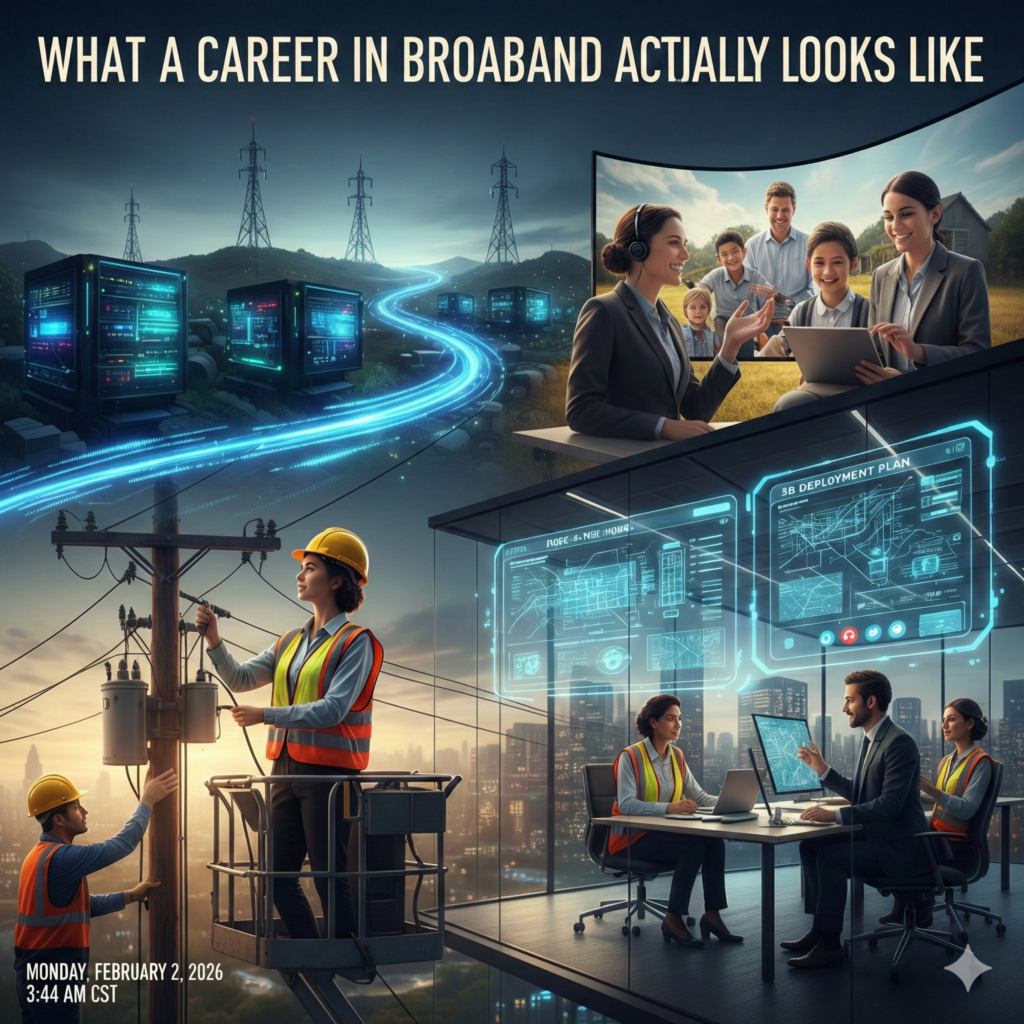
Carson Cooper spent six weeks last year in rural Nevada, hiking mountainous terrain, carrying equipment, and inspecting utility poles. Some days started cold and ended hot. One route meant a six-mile walk, three miles in and three miles back, with no vehicle access.
That wasn’t something he studied in college. It was something he learned on the job.
Before joining CHR Solutions, Carson knew very little about the broadband industry. He studied drones at Southeast Missouri State University and expected to work in aviation or mapping. A professor connected him to CHR’s growing drone program, and a few conversations later, he was starting full-time.
Now he works as a telecom technician, supporting broadband network design and field operations. His days split between route design, field work, and supporting CHR’s drone team. Some days are spent behind a screen working through Global Positioning System (GIS) and design files. Other days are spent outside, walking routes and seeing firsthand what crews deal with in the field of broadband infrastructure
Learning by Doing
Carson gained most of his telecom knowledge in his first few months. He didn’t come in with direct experience, and that wasn’t a problem. Learning happened quickly because the work had real constraints (or: because he was working on active projects from day one). Designs had consequences. Field conditions changed plans. Asking questions was expected.
GIS became essential fast as Carson learned it on the job. It connects drone data to route design and makes field work usable back in the office. Carson now recommends that anyone interested in drones also learn GIS and spend time understanding how fiber networks are actually built.
One thing that surprised him most was scale. Cell service, home internet, and basic connectivity all trace back to telecom infrastructure. Once you see it in the field, you don’t unsee it. Poles, routes, and easements stop being background details and start looking like systems that keep everything running.
Field work changed how he approaches design. Hiking routes and doing pole inspections made it clear that plans on a screen don’t always match reality. Terrain matters. So does access. So does distance. That experience helps him design routes that actually work for crews.
The work was not easy but finishing it mattered. Coming from Missouri, Carson wasn’t used to steep, rocky terrain. Completing the job on time and doing it right proved something to him. He could handle work outside his comfort zone.
That sense of responsibility is why the career sticks.
Broadband is a Long-Term Path
Carson sees broadband as long-term work because demand keeps growing. People need internet access for work, communication, and daily life. In rural areas, he met residents who had never heard of fiber cable but were excited to get it. Seeing that reaction made the work feel concrete.
For skills, he points to teamwork and communication first. Asking questions, sharing ideas, and speaking up matter more than having the perfect background. An engineering degree helps, but curiosity and willingness to learn matter more.
His advice to anyone considering the field is simple. Ask questions. Expect to fix mistakes. Treat setbacks as part of the learning curve.
The job offers variety, responsibility, and real-world impact early in a career. For people who want work that moves between the field and the office and leads to tangible results, broadband delivers that faster than most industries.
Broadband Careers: Common Questions
Q. What does a career in broadband actually involve?
A. Broadband careers often combine office-based design work with time in the field. Roles can include route design, GIS mapping, inspections, drone data analysis, and collaboration with construction crews. The work connects planning on a screen to real-world conditions and infrastructure.
Q. Do you need a telecom or engineering background to work in broadband?
A. No. A telecom or engineering background can help, but it is not required. Many people enter the industry from fields like drones, GIS, construction, or IT. Willingness to learn, ask questions, and adapt mattered more than prior industry experience. Skills like GIS, problem solving, and curiosity translated quickly into broadband work.
Q. Why choose the broadband industry for a long-term career?
A. Broadband is a long-term infrastructure industry driven by ongoing demand for internet access. Networks require planning, construction, maintenance, and expansion over time. This creates stable career paths with opportunities to grow into more specialized or leadership roles while working on projects that directly impact communities.