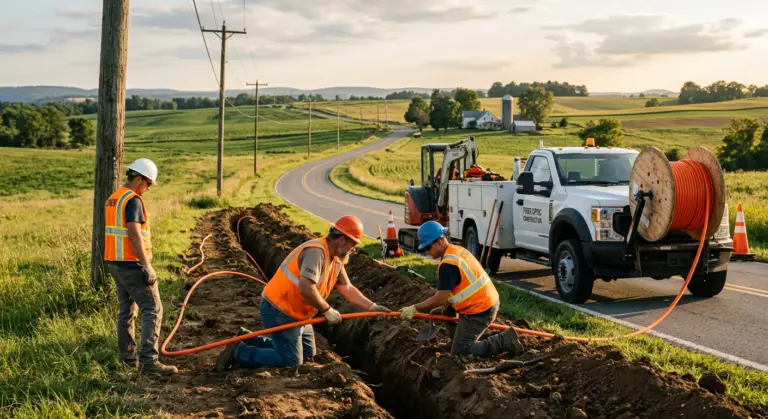

A Practical Guide to Reducing Costs, Accelerating Deployment, and Building Reliable, Future-Ready Networks

In the race to expand broadband infrastructure across the United States, detailed route planning is one of the most critical—and often underestimated—phases of fiber optic network deployment. From the first draft of a design to long-term maintenance decades later, the accuracy and thoroughness of the route plan directly influence project costs, timelines, network performance, and operational efficiency.
This blog explores five core reasons why route planning matters, as well as the tools and techniques that make it successful. Drawing on industry best practices and CHR’s extensive experience in U.S. network builds, this guide offers a roadmap for deploying broadband infrastructure that’s both cost-effective and built to last.
1. Cost Optimization & Avoidance of Unforeseen Expenses
The route you choose doesn’t just determine where the fiber runs—it sets the financial foundation for your entire build.
- Minimized Construction Costs: By carefully selecting the path, planners can avoid unnecessary trenching, difficult terrain, expensive boring, or rock excavation.
- Reduced Material Waste: Accurate route planning produces precise Bills of Materials (BOM) and Bills of Quantities (BOQ), ensuring you order only what you need.
- Efficient Use of Labor & Equipment: Knowing the route in advance allows for optimal crew scheduling and equipment allocation.
- Less Rework: Avoiding unexpected on-site changes helps prevent costly re-digging, re-splicing, or re-routing.
2. Speed of Deployment & Timeline Adherence
For U.S. ISPs working under grant deadlines or seasonal construction constraints, time is money.
- Streamlined Permitting: Detailed plans include accurate property boundaries, rights-of-way (ROW), and utility crossings, reducing permit approval delays.
- Faster, More Predictable Construction: Crews work efficiently when they have a clear, obstacle-free path from day one.
- Avoidance of Legal/Regulatory Setbacks: Accurate routes help prevent property encroachments, non-compliance fines, and work stoppages.
3. Enhanced Network Performance & Reliability
A fiber network’s performance depends on its physical design.
- Optimized Signal Integrity: Avoiding excessive bends, long unamplified runs, and environmental interference preserves signal strength.
- Reduced Risk of Physical Damage: Proactive planning accounts for hazards like flood zones, unstable soil, and busy traffic corridors.
- Strategic Splice Points: Fewer, better-placed splices mean lower signal loss and easier maintenance.
- Built-In Scalability & Redundancy: Planning ahead allows for future expansion and backup pathways.
4. Effective Maintenance & Troubleshooting
Once construction is complete, a network’s value depends on its maintainability.
- Accurate As-Built Documentation: Detailed route plans form the basis for precise records of every cable, splice, and piece of equipment.
- Faster Fault Resolution: Accurate maps allow technicians to pinpoint outages quickly, reducing downtime.
- Better Planning for Upgrades: Reliable documentation simplifies future enhancements or reroutes.
5. Stakeholder Coordination & Communication
Route planning isn’t just about engineering—it’s about relationships.
- Utility Coordination: Identifying and mapping existing infrastructure helps avoid conflicts with gas, water, electric, and other telecom lines.
- Landowner & Community Engagement: Accurate maps improve easement negotiations and public communication, reducing disputes.
- Project Transparency: Clear plans support reporting to grant authorities, municipalities, and internal stakeholders.
6. Tools & Techniques for Detailed Route Planning
The best results come from combining expertise with the right technology.
- Geographic Information Systems (GIS): Essential for mapping terrain, infrastructure, and environmental constraints.
- Site Surveys & Feasibility Studies: On-the-ground inspections uncover issues that maps alone can’t.
- Computer-Aided Design (CAD): Produces precise, compliance-ready engineering drawings.
- Route Optimization Software: Analyzes cost, terrain, and obstacles to find the best path.
- Collaboration Platforms: Keeps designers, engineers, surveyors, and construction teams in sync.
In the competitive U.S. broadband market—driven by initiatives like BEAD, RDOF, and state-level funding—detailed route planning isn’t a “nice to have.” It’s the backbone of a cost-efficient, high-performing, and future-ready network. Skimping on this phase almost always leads to higher costs, missed deadlines, and long-term reliability issues.
CHR’s Engineering Team has decades of experience designing and executing fiber network builds across diverse U.S. terrains and regulatory environments. We combine industry expertise with advanced planning tools to deliver accurate, build-ready designs that save time, reduce costs, and improve long-term performance.
Contact us today to discuss how our detailed route planning services can help you build smarter from the start.
CHR can help guide your team through the updated permitting process and ensure full compliance at every step. Contact us today.